
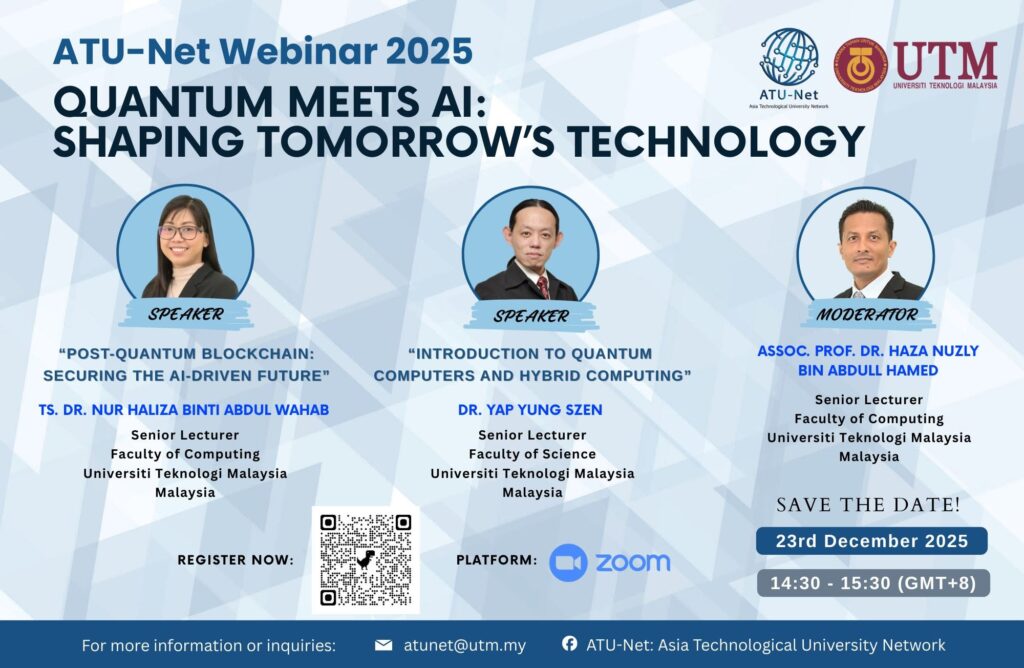
JOHOR BAHRU, Dec 23 – The Asia Technological University Network (ATU-Net) has organised the ATU-Net Webinar 2025 with Universiti Teknologi Malaysia (UTM) as the host, with the theme “Quantum Meets AI: Shaping Tomorrow’s Technology”.
Utilising the Zoom platform, this webinar was attended by more than 40 participants consisting of not only students but also academic staff from various countries.
To explore the powerful convergence of quantum technologies and artificial intelligence (AI), Ts. Dr. Nur Haliza Abdul Wahab from the Faculty of Computing, and Dr. Yap Yung Szen from the Faculty of Science were invited as guest speakers. The webinar was moderated by Assoc. Prof. Dr. Haza Nuzly Abdull Hamed from the Faculty of Computing. All of them are from UTM Johor Bahru.
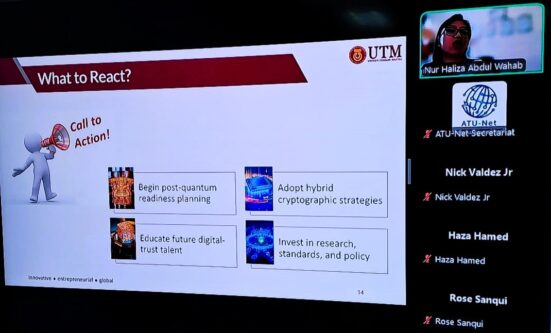
Started by Dr. Nur Haliza, she emphasised the urgent need to secure AI systems with post-quantum blockchain to maintain trust in a quantum computing era.
“The future of AI depends not on intelligence alone, but on trust that can survive quantum distributions.” She elaborated that AI systems are increasingly autonomous and make decisions without human oversight, which raises risks and accountability challenges. Blockchain can ensure transparency and auditability for AI decision-making, but current blockchain cryptography (RSA, ECC) is vulnerable to quantum attacks.
Therefore, post-quantum cryptography (PQC) algorithms based on hard mathematical problems are critical to re-engineer digital trust and secure blockchain against quantum threats. Concluding her session, Dr. Haliza said: “Artificial intelligence will shape the future, blockchain will anchor trust, and post-quantum cryptography ensures that trust survives technological disruption.”
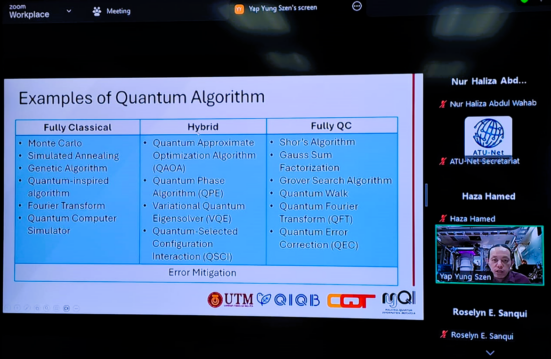
Dr. Yap Yung Szen explained quantum computers process information using qubits, enabling massive parallelism unlike classical bits, which makes tackling problems infeasible on classical computers. However, he highlighted that hybrid quantum-classical computing is the current practical approach, combining quantum processors with classical computers to maximise performance.
In addressing the availability of quantum computers, he stated: “Quantum computing is not designed to replace personal computers but to complement or replace large-scale supercomputers for specific complex tasks.” This means everyday users will not have personal quantum computers but will benefit indirectly from advances enabled by quantum-enhanced computing.
Dr. Yap Yung Szen ended his presentation by informing about the Malaysia Quantum Information Initiative (MyQI) which fosters local expertise and research collaboration in hardware and software development.
The webinar was concluded with an alternating Q&A between the two speakers, followed by a brief photo session.
ATU-Net is a strategic international alliance established to connect technology-focused institutions of higher learning in Asia. Currently, there are 50 member institutions from Malaysia, Brunei, Thailand, Indonesia, Philippines, Vietnam, Japan, India, China, Bangladesh, Uzbekistan, Pakistan, and Türkiye.
As part of its key initiatives, ATU-Net Webinar is a signature series of ATU-Net, aimed at providing a platform for global learning and professional networking.
You may reach out to email atunet@utm.my, for the recording of the webinar.
